Original data · updated 7 September 2026
Why your CV does not match the job description
By Hillel Lithwick, founder of ApexHunt · Melbourne
Your CV usually does not match the job description because the evidence is written in your words rather than the ad's: a tool you have used but never named, a sector you have worked in but never stated, a team you led without saying how big. Across 1,053 documented gaps from 212 real scored senior Australian applications, those writing problems outnumber genuine missing experience. The fix is to compare your CV against the specific job description, line by line, and close the named gaps before you apply.
The five most common mismatches
| Gap | Share | What it looks like |
|---|---|---|
| Sector experience is not evidenced | about 14% | The experience exists but the CV never states the sector in the words the ad uses. |
| A named tool or platform is missing | about 11% | The ad names software the CV never mentions, though the candidate has often used it. |
| Strategic-level work is not evidenced | about 5% | Delivery is well covered; setting the strategy is asserted rather than demonstrated. |
| A certification or qualification is missing | about 3% | Degrees, PMP, CPA and similar hard requirements. |
| Scale of people leadership or budget is unclear | a few percent | The CV says "led the team" or "owned the budget" without the number the ad asks for. |
| A requirement specific to the role | about two thirds | Real gaps, each its own: an interface, a standard, a regulatory process the ad names. |
The pattern: translation, not experience
Look at the top three. A named platform the candidate has probably used and never wrote down. A sector they have worked in but never named in the ad's vocabulary. Teams they led whose size never made it onto the page. None of these is a gap in the career; each is a gap in the writing, and each is fixable this evening. The genuinely hard gaps, missing certifications and undemonstrated strategy work, are the minority.
This is also why a generically "good" CV keeps under-performing against specific ads: every ad screens in its own vocabulary, and the terms that keep appearing differ by discipline. The document that reads beautifully in general can still fail the specific match.
What to do about it
Before applying: pull the ad's named tools and check each one appears in your CV in exactly the ad's spelling; state your sector in the ad's words; put a number on every team and budget you have owned. Then measure instead of guessing: score the CV against the ad, read the gap list, and rewrite against the named gaps only if the score says it will pay.
How ApexHunt compares your CV against a job description
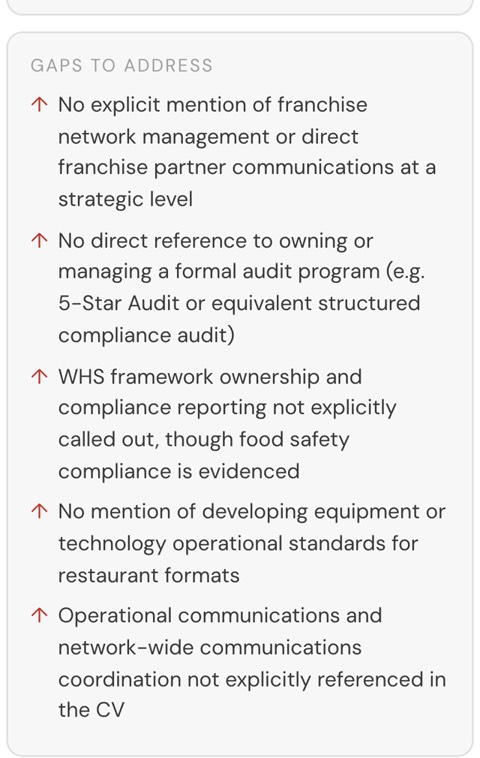
Paste the ad, or its link, and ApexHunt compares your CV against that specific job description: it extracts the ad's requirements and named terms, checks each one against the evidence in your CV, and returns a match score with the gaps listed and ranked. Every gap names the requirement in the ad's own words, so you can see whether it is a translation problem (the experience exists, the phrasing does not) or a real one. This is what a free account does, with no card and no trial.
Sources and further reading
- Harvard Business School, Hidden Workers: Untapped Talent (2021): 88% of employers say qualified high-skills candidates are vetted out because they do not match the exact job-description criteria, rising to 94% for middle-skills roles.
- myGov, Changing your career: The Australian Government's own advice for career changers starts with identifying the skills a role needs and the gaps you have.
Common questions
Why does my CV score low against a job I know I can do?
Usually because the ad screens in its own vocabulary and your CV answers in yours. The three most common gaps in our data, a named tool, an unstated sector and an unsized team, are all cases where the experience exists and the words do not. Rewrite those lines in the ad's terms and rescore before you conclude anything about your experience.
Should I copy keywords from the job description into my CV?
Only where they are true. A named platform you have used belongs in your CV in the ad's spelling; a platform you have not used does not, and a screener who probes it will find out. The comparison shows which terms are genuinely missing so you add evidence, not padding.
Is this the same as an ATS score?
No. There is no universal ATS score, because every employer runs different software with different settings. ApexHunt reports keyword coverage as a baseline and scores whether your evidence proves the role, which is what a human reader decides on.
How long does the comparison take?
Under a minute for the score and gap list. Rewriting against the gaps is a separate step, and the measured method for that starts from the same gap list.
Methodology
Gap shares computed 10 September 2026 from ApexHunt production data by a saved query: 1,053 individually documented gaps across 212 senior Australian job ads scored by external users against their actual CVs, classified by pattern, so the shares are approximate. All figures are aggregates; no individual CV, user or employer is identifiable. Our users skew toward senior retail, ecommerce and marketing roles in Melbourne and Sydney, so the mix describes that world best. That describes the data, not the product: ApexHunt scores your CV against roles anywhere in Australia, whether the ad is in Sydney, Brisbane, Perth, Adelaide or a regional centre.